Equip your workforce with industry-leading height safety and rescue capabilities in the demanding wind energy sector with our certified GWO Working at Height (WAH) Initial Module. Delivered at South West Maritime Academy under the revised GWO BST V20 Standard, this comprehensive 2-day standalone module provides the vital theoretical knowledge and practical climbing proficiency required to work safely at height and perform emergency rescues in wind turbine generator (WTG) environments.
From comprehensive pre-use inspections of Personal Fall Protective Equipment (PFPE) and guided fall arrest systems to complex ladder rescues, suspension trauma mitigation, and tool tethering, our Working at Height Initial Training (WAH) combines rigorous safety principles with realistic practical scenarios. Gain the essential, globally recognised certification required for onshore and offshore wind site compliance across the UK and internationally.
GWO Working at Height Details
Booking Info
Cromhall Quarry, Cromhall, South Gloucestershire, GL12 8AA.
Already hold an in-date GWO Working at Height certificate?
Looking for the GWO Working at Height Refresher (WAHR)?Height Safety & Rescue Excellence: GWO Working at Height Module
Working on modern wind turbines requires absolute confidence, acute situational awareness, and total mastery of Personal Fall Protective Equipment (PFPE). The GWO BST Working at Height Module is engineered to equip technicians, engineers, and site specialists with the critical skills needed to operate safely on vertical ladder systems, service platforms, and nacelle structures.
Under the revised GWO BST V20 Standard, Working at Height is delivered as an intensive, standalone module focused on practical safety and rescue execution. Delegates learn to independently select approved structural anchor points, maintain a minimum fall factor, eliminate dropped object hazards through tool tethering, and perform prompt casualty rescues using specialised rescue descent devices.
1. PFPE Pre-Use Inspection & Fitting
Master the generic approach to safety equipment, identifying standard markings, inspection periods, and correct harness ergonomics.
- Harness & Hardware Inspection: Performing comprehensive pre-use checks on full-body harnesses, vertical fall arrest sliders, work positioning lanyards, and connectors.
- Correct Adjustment: Fitting and adjusting full-body harnesses to a snug fit, ensuring proper positioning of chest, leg, abdominal, and dorsal attachment points.
2. Fall Prevention & Work Positioning
Apply the critical principle of fall prevention over fall arrest to ensure 100% tie-off and hands-free working security.
- Work Positioning: Connecting work positioning lanyards safely to side D-rings and structural anchor points to allow hands-free work operations.
- Anchor Selection: Identifying certified anchor points and approved structural anchors (including reinforced ladder rungs where specified in turbine manuals).
3. Vertical Fall Arrest Systems & Lanyards
Gain practical proficiency using guided fall arresters and energy-absorbing double-hook lanyards during vertical progression.
- Guided Type Arresters: Pre-use checking, attaching, functional testing, and climbing on vertical cable, rail, and wire ladder systems.
- Fall Factors & Indicators: Minimising fall factors (maintaining FF < 0.5), double-hook climbing techniques, and identifying deployed fall indicators.
4. Dropped Objects Prevention & Tool Tethering
Implement proactive dropped object controls, dynamic buddy checking, and tool management in high-consequence drop zones.
- Tethering & Housekeeping: Securing tools, accessories, and components using approved three-point tethering systems and rated closed-top tool bags.
- Drop Zone Management: Establishing exclusion zones, covering openings/hatches, and conducting mandatory pre-climb buddy checks.
5. Emergency Descent & Evacuation
Develop rapid emergency egress capabilities from nacelles and tower sections using constant-rate descender devices.
- Evacuation Kits: Pre-use inspection, rigging, and deployment of dedicated WTG evacuation and escape equipment.
- Controlled Descent: Executing safe solo evacuation and experiencing controlled descent speeds from height platforms with adequate clearance.
Complete BST Training Package
Need all mandatory GWO certifications for full onshore or offshore site access? Book our comprehensive 4.5-day BST package:
Full Pathway Package:
GWO Basic Safety Training (BST) PackageThe SWMA Advantage: Realistic Vertical Rig Training
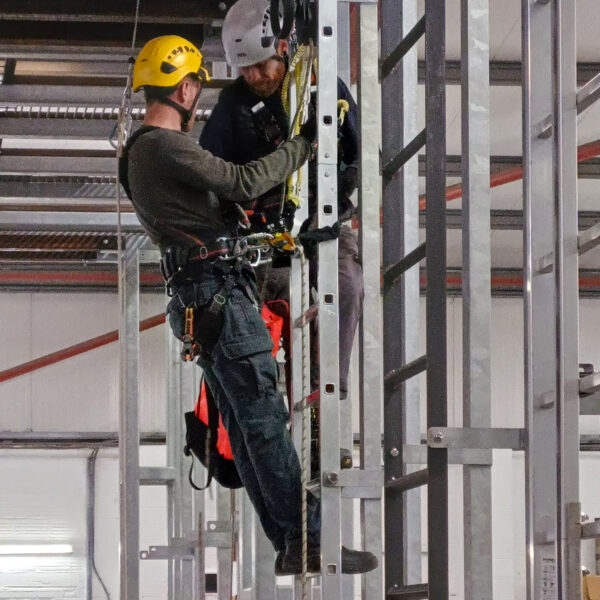
At South West Maritime Academy, we go far beyond standard classroom theory. Our dedicated working-at-height structures at Cromhall Quarry replicate the true scale, vertical ladders, confined internal platforms, and anchor layouts found in modern wind turbine generators.
Delegates train with operational fall arrest gliders, self-retracting lifelines (SRLs), and advanced rescue hubs under the close supervision of industry veterans. You leave with real muscle memory, genuine confidence, and rapid WINDA certification uploads within 24 hours.
Entry Requirements
This GWO Working at Height Initial course is designed for personnel working, or seeking employment, in the onshore and offshore wind energy sector. It provides wind turbine technicians, site engineers, rope access operatives, blade technicians, and commissioning crews with mandatory height safety certification.
This course involves physical climbing, vertical ascents, descent exercises, and casualty rescue drills from height structures. Full attendance and active participation across all practical drills are required to achieve GWO certification.
- Minimum Age: Participants must be at least 18 years of age.
- Physical Fitness: Candidates must be in good health, free from medical conditions that could be aggravated by working at height, and capable of practical climbing and physical exertion. A medical self-screening declaration is completed prior to training.
- WINDA Registration: Delegates must register on the GWO WINDA database and provide their WINDA ID prior to course commencement.
- Prior Experience: No previous height safety experience is required for this initial 2-day course. (Please note: this course is designed for training and is not an assessment to overcome a fear of heights).
Contact & Accommodation
Corporate & Group Enquiries
Telephone: 01454 260130
Email: info@southwestmaritimeacademy.com
Monday – Friday: 08.30 – 17.00
Local Accommodation
There is a wide range of local accommodation, some of which are within walking distance of the training centre, to suit every budget.