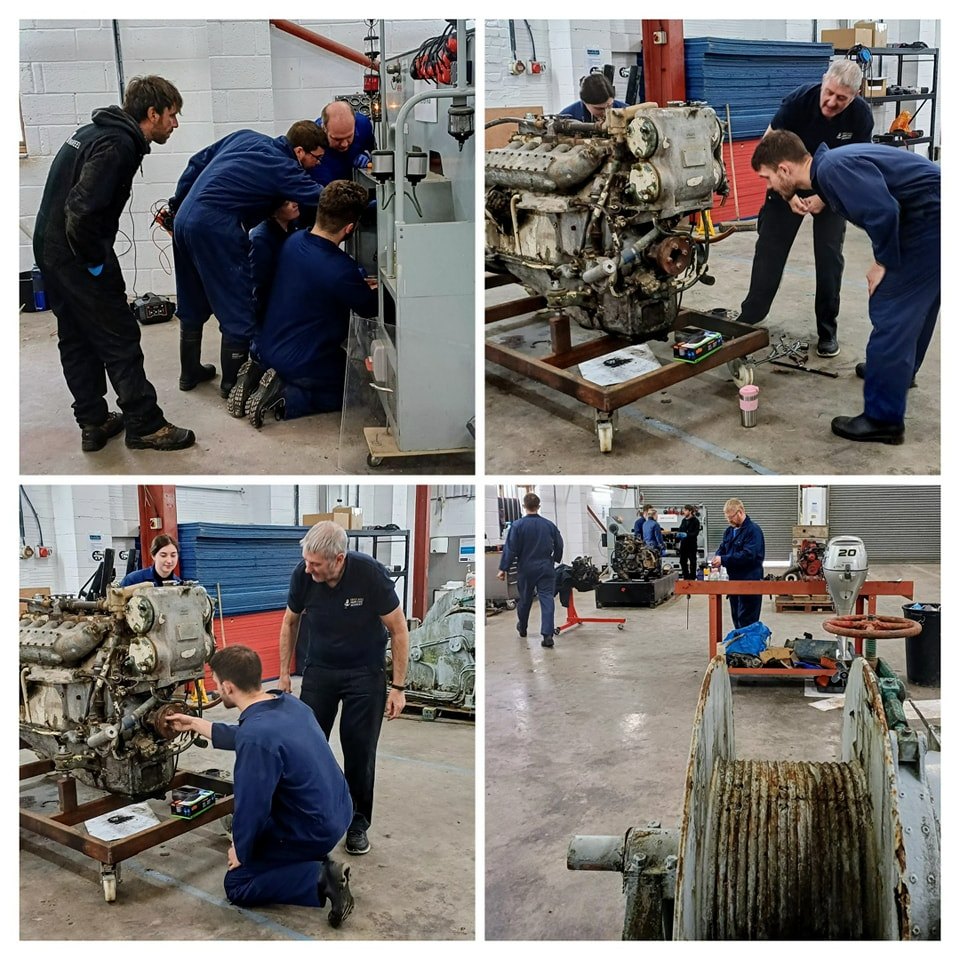
Take the crucial first step into professional marine engineering with our MCA Approved Engine Course 1 (AEC1). This comprehensive, five-day program delivers the vital hands-on competencies and fundamental theoretical knowledge required to safely operate and maintain small commercial workboats, luxury superyachts, and offshore support craft.
Designed explicitly to meet the rigorous safety standards laid down by the Maritime and Coastguard Agency Codes of Practice, our AEC1 course covers the full operational mechanics of marine diesel systems. Whether you seek a dual-role deck/engineer status or a foundational route toward your MCA engineering progression pathway, this training ensures total confidence when operating machinery in isolated offshore environments.
AEC1 Course Details
Booking Info
Cromhall Quarry, Cromhall, South Gloucestershire, GL12 8AA.
Ready to advance your marine engineering career?
Book AEC1 & AEC2 Package & Save Over £160What is the MCA Approved Engine Course and who is it for?
The MCA Approved Engine Course 1 (AEC1) takes seafarers from an entry-level knowledge expectation right through to a benchmark where they can confidently manage, operate, and troubleshoot a diesel engine on a maritime vessel. While advanced certifications require extensive sea time, the AEC1 course offers an open-access gateway for deck crew, yacht stews, and commercial fishermen to expand their shipboard values.
Our curriculum does not attempt to make expert diesel engineers out of you over a single week. Rather, the primary instructional focus remains centered on mechanical self-reliance. Taught by highly experienced marine engineers, this training ensures that if a fuel line blocks or an electrical cooling circuit trips under load, you can rapidly carry out regular maintenance, perform safety checks, and troubleshoot problems effectively.
1. Engine Topography & Operations
Master the internal operational cycles and underlying construction details that govern marine compression ignition engines.
- Principles: Compression ignition engines and foundational internal workflows.
- Construction: Cycle of operation and thorough constructional details of the power plant.
2. Systems, Supplies & Air Supply
Acquire practical systems knowledge concerning safe fuel handling, lines filtration, and the parameters of air induction.
- Fuel Delivery: The complete fuel system mechanics and injector safety tasks.
- Combustion Air: The dynamic role of air in the combustion process.
3. Cooling & Lubrication Systems
Understand the critical support configurations responsible for preventing catastrophic structural failures under temperature load.
- Thermal Balance: The cooling system configuration, raw intake loops, and sea cocks.
- Friction Shield: The lubrication system mechanics, viscosity checks, and pressure maintenance.
4. DC Electrical & Auxiliary Hardware
Demystify low-voltage electric configurations, auxiliary installations, and hull fittings parameters.
- Power Distribution: Engine electrical systems, battery banks, alternators, and starter components.
- Hull & Auxiliary: Hull fittings, through-hull monitoring, and bottled LPG installations.
5. Power Transmission & Pollution Control
Trace raw power from the engine flywheel down to the propeller while maintaining structural maritime legal compliance.
- Drive Assemblies: Power transmission architectures, gearboxes, and propeller shaft alignments.
- Environmental Codes: Marine pollution prevention, MARPOL awareness, and the Code of Safe Working Practices.
Natural Career Progression
Once you achieve your initial Approved Engine Certificate 1, you can seamlessly step onto the next framework tier of commercial engineering status:
Next Advanced Step:
MCA Approved Engine Course 2 (AEC2) ModuleEntry Requirements and Target Audience
This AEC1 course represents the mandatory entry-level criteria for individuals seeking commercial engineering responsibility on motor or sailing yachts over 24m, small commercial workboats, and regional pilot craft. It is heavily favored by deck crew looking to drastically maximize their employability via dual-role capability.
All safety equipment and specialist tools required for the workshop segments are supplied by South West Maritime Academy as required. Full attendance throughout the 5 days is mandatory to prepare you for the final exam.
- Minimum Age: Participants must be at least 18 years of age prior to the start of the program.
- Prerequisites: None. There are no formal engineering prerequisites or sea service conditions required to take the initial course.
- Physical Suitability: Candidates should possess basic manual dexterity to handle tools safely within an active workshop environment.
AEC1 Frequently Asked Questions
What does AEC1 stand for in marine engineering training?
Does the MCA AEC1 certificate expire?
Do I need prior mechanical experience to take this training?
What size vessels can I operate with an AEC1 ticket?
What is the main operational difference between AEC1 and AEC2?
Is the AEC1 course mandatory for entry-level superyacht deckhands?
Where can I find MCA approved engine courses near Bristol or South Wales?
Do I need to bring my own tools or boiler suit overalls?
Contact & Accommodation
Contact Us
Telephone: 01454 260130
Email: info@southwestmaritimeacademy.com
Monday – Friday: 08.30 – 17.00
Accommodation
There is a wide range of local accommodation, some of which are within walking distance of the training centre, to suit everyone’s budget.