Maintain your operational site readiness and revalidate your height safety competence with our certified GWO Working at Height Refresher (WAHR) Module. Delivered at South West Maritime Academy under the revised GWO BST V20 Standard, this intensive 1-day course builds upon your existing experience to ensure your vertical safety, emergency descent, and casualty rescue techniques remain fully aligned with the latest industry best practice.
Structured into practical training Scenarios, this standalone refresher ensures technicians can independently inspect Personal Fall Protective Equipment (PFPE), manage dropped object hazards, prevent suspension trauma, and execute rapid single-rescuer ladder retrievals. Revalidate your globally recognised GWO certification for a further 24 months across onshore and offshore wind energy projects.
GWO WAHR Course Details

Booking Info
Cromhall Quarry, Cromhall, South Gloucestershire, GL12 8AA.
Need full safety revalidation across all modules?
View Full BST Refresher PackageRevalidate Your Height Competence: GWO Working at Height Refresher
Staying sharp and up to date with the latest vertical safety protocols is essential for anyone operating in the fast-evolving wind industry. The GWO Basic Safety Training Refresher Working at Height Module is designed to review and build on your existing practical skills, refreshing critical emergency response techniques and reinforcing safe behaviours on turbine structures.
Under the revised GWO BST V20 Standard, all refresher training is structured into two sequential phases: foundational Skill Stations to demonstrate individual competence, followed by dynamic, industry-relevant Training Scenarios that simulate real turbine emergencies under realistic operational conditions.
1. PFPE Inspection & Fitting Stations
Refresh your ability to carry out pre-use checks, identify formal approval markings, and correctly fit full-body harnesses.
- Equipment Checks: Demonstrating pre-use inspection of harnesses, guided-type fall arresters, lanyards, and connectors under generic principles.
- Harness Adjustment: Ensuring optimal snug fit and correct alignment of dorsal, sternal, and side attachment points.
2. Fall Prevention & Work Positioning
Review the application of fall prevention systems and the selection of certified structural anchor points.
- Work Positioning: Connecting and adjusting work positioning lanyards to maintain hands-free working security safely.
- Anchor Assessment: Verifying approved structural anchor points, including marked reinforced ladder rungs specified in turbine manuals.
3. Vertical Fall Arrest & Lanyard Progression
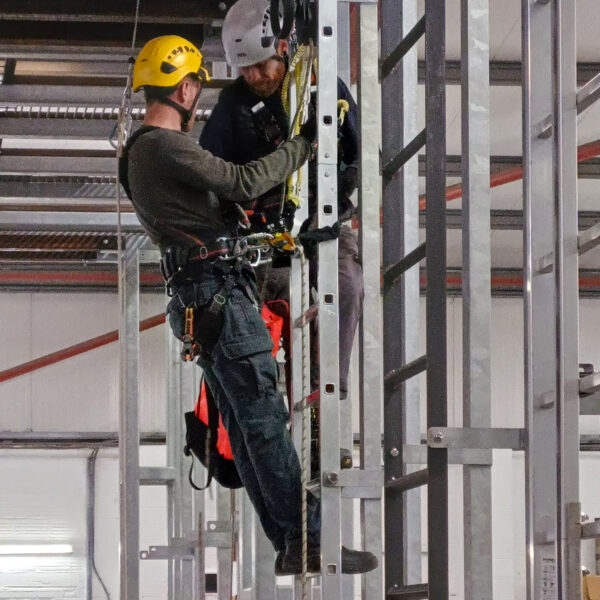
Practise vertical ladder climbing using guided fall arresters and double-hook energy-absorbing lanyards.
- Slider Attachment: Attaching, functional testing, and climbing with guided-type fall arresters on vertical rail, cable, or wire systems.
- Fall Factor Control: Applying double-hook climbing techniques that minimise potential free-fall distances (maintaining FF < 0.5).
4. Dropped Object Controls & Buddy Checks
Reinforce essential dropped object prevention measures, tool tethering standards, and peer-to-peer safety checks.
- Tool Tethering: Securing tools, parts, and equipment using approved tethering attachments and rated closed-top tool bags.
- Peer Accountability: Conducting thorough pre-climb buddy checks on PPE and tethered items prior to ascending the tower.
5. Emergency Descent & Double Evacuation
Practise rapid, controlled emergency egress procedures using constant-rate evacuation descender devices.
- Rescue Hub Setup: Pre-use inspection and rigging of dedicated WTG evacuation and escape devices.
- Evacuation Scenarios: Executing safe solo descent and double evacuation drills from height platforms with adequate clearance.
6. Casualty Rescue & Ladder Retrieval
Execute single-rescuer retrieval scenarios to recover an incapacitated colleague suspended on a turbine ladder.
- Ladder Rescue: Rigging active and passive rescue configurations to safely lower an unconscious casualty to the platform.
- Suspension Trauma: Managing the hazards of suspension syncope, orthostatic shock, and providing immediate post-rescue care.
The South West Maritime Academy Advantage
At South West Maritime Academy, our Working at Height Refresher ensures experienced wind technicians gain meaningful, challenging practice rather than routine tick-box exercises. Our dedicated vertical rigs at Cromhall Quarry feature realistic ladders, guided fall arrest lines, and confined compartments that mirror real operational assets.
Led by expert working-at-height instructors with extensive offshore and onshore experience, we focus on dynamic learning moments, constructive peer feedback, and ensuring your WINDA records are uploaded swiftly.
Entry Requirements
This GWO Working at Height Refresher course is designed for experienced wind technicians, engineers, and site personnel who require revalidation of their height safety certification.
This refresher involves practical climbing, descending, and casualty rescue drills from height structures. Full attendance and active participation across all Skill Stations and Training Scenarios are required to achieve revalidation.
- Prerequisites: Participants must possess a valid, in-date WINDA record for GWO Working at Height (Initial or Refresher).
- Minimum Age: Candidates must be at least 18 years of age.
- Physical Health: Delegates must be medically fit and capable of participating in practical vertical climbing and rescue exercises. A medical self-screening declaration is completed prior to training.
- WINDA Registration: Delegates must provide a valid WINDA ID prior to course commencement.
Contact & Accommodation
Corporate & Group Enquiries
Telephone: 01454 260130
Email: info@southwestmaritimeacademy.com
Monday – Friday: 08.30 – 17.00
Local Accommodation
There is a wide range of local accommodation, some of which are within walking distance of our training centre at Cromhall Quarry, to suit every budget.